What is DNS?
DNS or Domain Name System is a very significant part of the internet architecture which performs the function of translating human understandable domain names into the corresponding IP addresses that computers use to identify each other.
In summary, DNS can be thought of as a phone book of the internet and people are able to get to the website using memorable web addresses such as www.example. com rather than an integer one such as 192. 0. 2. 1.
When a user types the domain name in Web browser, it sends a query to the DNS resolver in the user’s device and the resolver will carry out the process of DNS resolution by contacting several DNS servers to get the IP address.
DNS is reliable and fast and these characteristics are important for its use in the contemporary culture of the Internet – making it one of the crucial elements of the technological world.
Why does it Needs TLS or HTTPS?
Privacy Protection
DNS queries and responses are transmitted in plain text, as there is no method to encrypt them, so any third party including ISPs, network administrators or hackers can intercept them.
This means that anyone with access to the data path can monitor the website users are visiting thus putting the users privacy at risk. This lack of encryption also means that third parties can monitor DNS queries to learn more about the users’ online activities.
These profiles can then be used for advertising, monitoring or any other activity that may be invasive of the individuals’ privacy.
Through the use of TLS for DNS (DoT) or DNS-over-HTTPS (DoH), users are able to shield their surfing habits from being monitored and recorded, thus improving their privacy.
Security Enhancement
The regular and unsecured DNS specification is prone to DNS spoofing or poisoning wherein the attackers modify the DNS response in-transit to reroute users to wrong websites.
This can lead to data such as login details or financial data being stolen from the target company. Also, guaranteeing the consistency of DNS data is necessary because the alteration of DNS responses can result in numerous security issues.
Read Also: SSH Vs. SSL/TLS – The Technical Differences Explained
DoT and DoH also have features that can be used to confirm the authenticity of the DNS responses received, and therefore the data has not been tampered with.
This minimizes the possibility of malicious parties leading users to dangerous websites and improves the security of Internet connections in general.
Standing Up to Censorship and Blocking
In some places, the ISPs or the government can interfere with the DNS queries and modify them to block specific websites.
For instance, DoH tackles the problem by incorporating DNS traffic with normal HTTPS traffic, and this makes it impossible for the censor to identify and block DNS queries while not affecting other services.
This defeats censorship attempts and guarantees users always have dependable access to the intended websites and services no matter the network they are in.
Through DNS traffic encryption, users can effectively counter censorship and have confidence in the availability of the intended services.
Adoption of Existing Security Infrastructure
Based on HTTPS protocol that is popular among websites and well known for its security in transfer of web page contents.
This enables DNS queries which are subject to HTTPS benefits from strong measures such as encryption, authentication, and protection of integrity.
Likewise, DoT builds upon the structures of TLS of internet communication security identified for safe communications on the Internet.
This means that by incorporating DNS queries as part of such security protocols, user traffic has been proven to be encrypted using standard cryptographic methods.
It not only increases the security of DNS traffic but also makes overall implementation easier by using security primitives that are already understood and accepted.
Enhanced Performance and Reliability
Implementing TLS for DNS (DNS-over-Transport or DoT) and operating DNS-over-HTTPS (DoH) also help here toward enhanced performance and dependability.
The protocols of the conventional DNS functioning in the plaintext pose vulnerability to a host of interferences and attacks affecting its operation.
Evaluating disruptions such as the ones presented above, it can be realized that by encrypting DNS traffic, both DoT and DoH contribute to more effective and less vulnerable DNS resolution.
Furthermore, contemporary adaptations of DoT and DoH minimize the efficiency loss by employing connection reuse and multiplexing to enhance the overall speed of DNS requests.
Thus, users enjoy faster and more reliable internet connections because encrypted DNS protocols can prevent and alleviate some disturbances of DNS workings.
What is DNS over TLS?
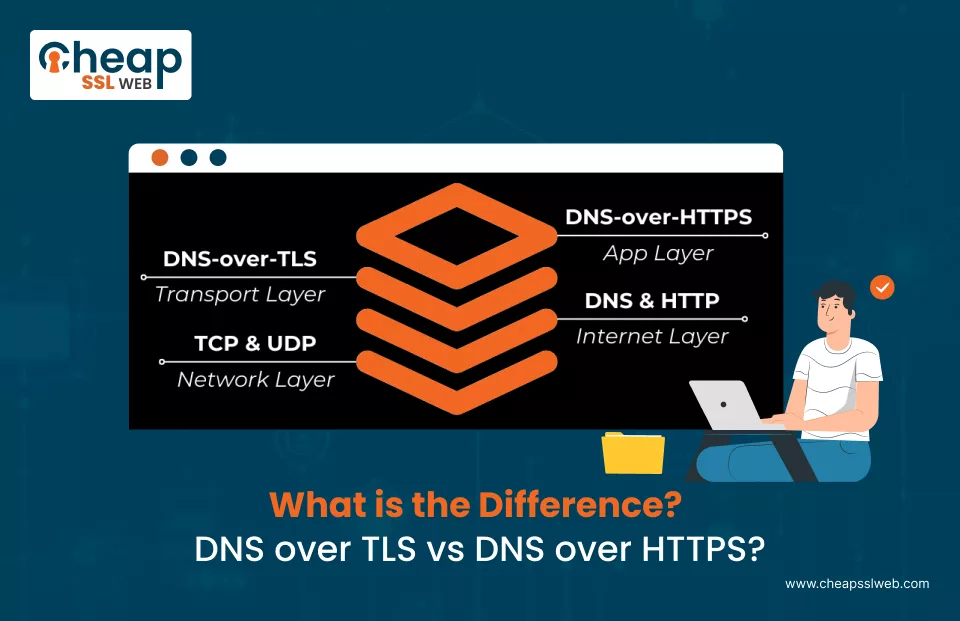
DNS over TLS (DoT) is specifically a security protocol that aims to increase the level of security for executing DNS requests by adding an additional layer of encryption between the DNS client and the DNS server.
Since DNS queries used to be sent in cleartext, anyone could listen, modify, or launch various attacks on the requests and responses between a DNS server and a client.
To solve these issues, DoT uses encrypted extremity [through using Transport Layer Security (TLS)] for the DNS questions that is generally used to secure https web traffic.
When making a DNS query using DoT, the client is confronted with an encrypted message to send over the networking interface.
This encrypts in such a manner that it eliminates the possibility of disgruntled ISPs, network administrators, or malicious third parties from intercepting and accessing the DNS data.
This also helped to confirm that the responses from the DNS server were as expected and had not been altered in any way. In general, DoT works through port 853; however, DoT stays aside to normal DNS traffic, which is taken through port 53.
However, DoT does not only solve the DNS security problem by encrypting the DNS queries through a dedicated port and with the help of TLS but also gives a solution.
This is for the verifiability problem by having mechanisms of the integrity and authenticity of DNS responses, which make the overall security and privacy of internet communications stronger.
What is DNS over HTTPS?
DoH stands for DNS over HTTPS, which is a protocol dedicated to make the DNS queries more private and secure by helping them transfer through HTTPS.
Originally, DNS queries are transmitted without proper encryption known as plaintext which can easily be intercepted and modified by third parties such as ISPs and network administrators.
The solutions to these challenges are offered by DoH, due to which the DNS queries themselves are encrypted within the HTTPS protocol, thus protecting the client-server DNS communication.
When a DNS query is initiated, the query sent through an HTTP connection is sent in the form of an HTTPS request to the concerned DoH-compliant DNS server.
The server processes the requested information and sends back an answer in the DNS response which is in turn wrapped in an HTTPS response.
Read Also: QUIC vs. TCP: Detailed Comparison
This makes the encryption to be the final security measure that checks to ensure that the DNS queries and responses are not easily intercepted or changed.
The main advantage of DoH is that it disguises queries as encrypted HTTPS web requests through the TCP connection on the well-known port 443.
Thus DoH requests are extremely difficult to block and filter, thereby increasing resistance to censorship and other forms of filtering. Moreover, web security has shown that HTTPS enhances DoH in terms of DNS security thanks to the presence of TLS encryption.
Difference between DNS over TLS & DNS over HTTPS
| Feature | DNS over TLS (DoT) | DNS over HTTPS (DoH) |
| Protocol | TLS (Transport Layer Security) | HTTPS (HTTP Secure) |
| Port | Typically uses port 853 | Typically uses port 443 |
| Encryption | Encrypts DNS queries using TLS | Encrypts DNS queries using HTTPS |
| Privacy | Provides encryption for privacy, preventing eavesdropping | Provides encryption for privacy, preventing eavesdropping |
| Performance | Generally faster due to less overhead compared to HTTPS | May have slightly higher latency due to HTTPS overhead |
| Compatibility | Requires DNS resolver and client support for TLS | Requires DNS resolver and client support for HTTPS |
| Use Case | Often used in dedicated DNS services and network configurations | Often integrated into web browsers and applications |
| Implementation Complexity | Relatively simpler as it adds TLS to existing DNS protocol | More complex as it involves full HTTP/2 or HTTP/3 protocol stack |
| Adoption | Supported by various DNS resolvers like Google Public DNS, Cloudflare | Increasingly supported by web browsers like Firefox, Chrome |
| Traffic Analysis Resistance | Less resistant to being blocked or monitored since it uses a unique port | More resistant to being blocked or monitored as it blends with regular HTTPS traffic |
Which is Better, DoT or DoH?
Deciding which option is the best one between DNS over TLS (DoT) and DNS over HTTPS (DoH) is generally challenging and depends a lot on the situation and the organization or the individual IT security professional in question.
Every single protocol has its benefits, or rather, its edges, and its efficiency depends on circumstances that surround its application.
In this case, we will have the ability to consider the major factors that are important from the perspective of network security and privacy when comparing both protocols, as well as the advantages and disadvantages of each.
Network Security Standpoint
In this comparison, from a network security point of view, people usually prefer DNS over TLS (DoT). A key advantage of implementing DoT is due to the core networks that assist in observing and controlling DNS queries.
As you can recall, DoT typically runs over a different port which is port 853 and this makes it easier for those managing the organization’s network security to quickly detect and block the traffic associated with DNS Server.
This visibility is paramount in monitoring network integrity since administrative personnel can capture and analyze other potential DNS requests.
Privacy Perspective
On the other hand, considering privacy, DNS over HTTPS (DoH) appeared to benefit from the circumstance.
Specifically, DoH incorporates queries for DNS within HTTPs, which is a procedure that employs port 443, the regular web traffic port.
Read Also: Port 80 (HTTP) vs. Port 443 (HTTPS): Major Difference
This encapsulation was to mean that the DNS queries are making part of the HTTPS traffic. Therefore, it becomes extremely difficult for any interconnecting parties like the ISPs, network administrators or hackers, or even any intruders to monitor or tamper with the users’ DNS queries.
Balancing Security and Privacy
The transition between DoT and DoH depends on the network security requirements compared to the user privacy necessity.
Each of the protocols has advantages in these aspects and the decision on which one to use in a given context depends on the nature of the risk and the importance of the outcomes to the organizational or individual entity concerned.
However, for organizations that place a premium on the security of their networks and have the resources to continually Src the traffic going through the DNS servers in use, DoT might be the optimal solution to adopt.
More specifically, because it has its own specialized port and clear traffic partition from other types of traffic, it can be better protected and more easily adapted to conventional and existing security architectures.
The administrators of the network can easily regulate the moved DNS traffic, ensure the existence of security measures, and react more effectively to threats.
Practical Considerations and Deployment
While implementing DoT, or DoH, there are certain generalized features that can be taken into account affecting the utilization of either of them, and the practical feasibility and efficiency of its use.
For example, DoH implementation has been introduced into most of the browser applications such as Firefox and Chrome, which makes the space not very complicated to be taken by end-users for configurations.
Such integration at the browser level would enable enthusiasts to work with a better privacy feature with less effort at their end.
On the opposite, DoT usually needs to be set up at a network level, including setup of DNS resolvers and checking whether the client device supports DoT.
This may admittedly take more time in setup as compared to independent implementation on every device but ensures that all of an organization’s devices and networks can be secured with the same or similar policies in force.
Conclusion
As you look for the affordable SSL certificates for your online business, CheapSSLweb is the best place to visit.
To provide your customers with the best service, CheapSSLweb has multiple products with the same SSL encryption level as more expensive vendors. Don’t take the risk – protect your website and your visitors now.

Secure your Website with SSL
Enables an Encrypted Connection between Website and Browser Using Trusted SSL Certificate Encryption!
Starts at Just $3.99/Yr